Steiners in Paris in the 80s

The 80s:

Culture, Community & Progress

December | Philip Remy

In 1989 the Wall fell. And with it, the end of the Federal Republic had come as Germans in the West had known it since its founding. Looking back, the last ten years up to that point—the 80s—were marked by a certain tranquillity that scarcely hinted at the upheavals to follow. In Stein as well.

True, the change that went hand in hand with the school’s “state recognition” had already begun, but essentially everything was still as it had been. There was no internet, no mobile phones, and the only gateway to the world was the old red railbus that took you to Traunstein to catch the train to Munich. And anyone who wanted to speak with their parents could be reached after dinner until nine o’clock. The old Bakelite telephone switchboard with rotary dial and hundreds of illuminated buttons stood in the office next to the kitchen, where assigned pupils were shut in for “telephone duty” to connect calls to the individual stations.

Niki Ziegler and his class, 80s

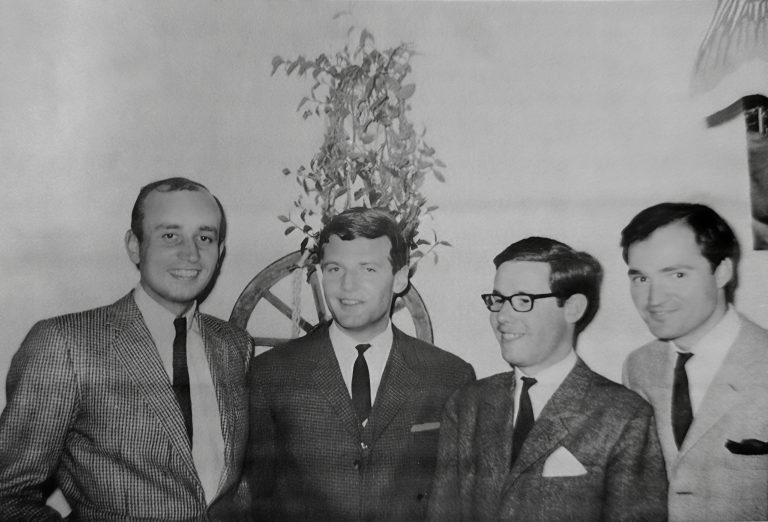
This “splendid isolation” contributed substantially to the special atmosphere at the school. The author took his Abitur in Stein in 1982 and returned at the beginning of 1984 for a year and a half as an Educator. In conversation with Angi Ziegler, he brought the memories of some highlights of the 80s in Stein back to life once more in December.

Against the backdrop of today’s omnipresence of entertainment options, it is scarcely imaginable that in the early years of the 80s there was still a film club in Stein. It had a professional 16 mm projector, the cowshed became a cinema, and via catalogue one could order reasonably current and culturally significant films, delivered in several reels. Screenings were always on Saturday evening; the hall was packed to the rafters every time. Angie Ziegler recalls, for example, Gorky’s “Summerfolk,” a film adaptation of Peter Stein’s production, which she had still seen with her husband at Hallesches Ufer in Berlin. “It really mattered to us that you should get a bit of education.”

By the nature of things, “Jaws” or “One Flew Over the Cuckoo’s Nest” found even greater approval among the pupils. From today’s perspective, these films too have long since become culture. As a further offering for the pupils’ edification, there was a subscription of 20 tickets to the Salzburg State Theatre for all performances. Afterwards, they would still go to dinner, which for many was the highlight of the excursion.

Sebastian Ziegler with his class

Participation in the annual theatre productions was taken up far more enthusiastically—though in the 80s this can hardly have been any different from the decades before. The Steiner theatre, performed for the parents’ evening, was always a highlight of the school year. To be sure, in the 80s there was a whole series of legendary productions, as Angi believes, to which the author was able to contribute as an actor and later also as author and director.

The opening was Oscar Wilde’s “The Importance of Being Earnest,” the comedy of the English upper class, which the Steiner pupils could, of course, portray with tremendous credibility. Costumes, as always, stylishly provided by Hilde Weymar and Angi Ziegler. Unforgettable for Angi Ziegler remains Susi Fischer as Aunt Augusta in the clothes of her mother-in-law, the school founder Ilse Wiskott. Direction at the time lay in the hands of the couple Theodor and Ingrid Kelle, who had to rein in the young talents rather than spur them on.

Equally unforgettable was the self-written parody on the introduction of private broadcasters in Germany, “SFS Sender Freies Stein”; and finally the adaptation of Wilde’s novella “The Canterville Ghost” and the open-air staging of the Moritat of “Robber Baron Heinz von Stein.” All resounding successes—first-rate entertainment with highly gifted amateur performers, certainly far above the level of typical school productions. Cum grano salis. Barbara Bondy from the arts pages of the Süddeutsche Zeitung, a long-standing friend of the Ziegler family and at that time engaged in Stein as German teacher for the upper level, would have preferred to see “Hugo von Hofmannsthal” staged. “She already saw the new developments,” says Angi Ziegler, “and also recognised the potential, for instance, of Thomas Gottschalk, to whom she sometimes compared you. But it was always followed by a sigh: “What he could achieve with young people.”

Theatre performance in the 80s

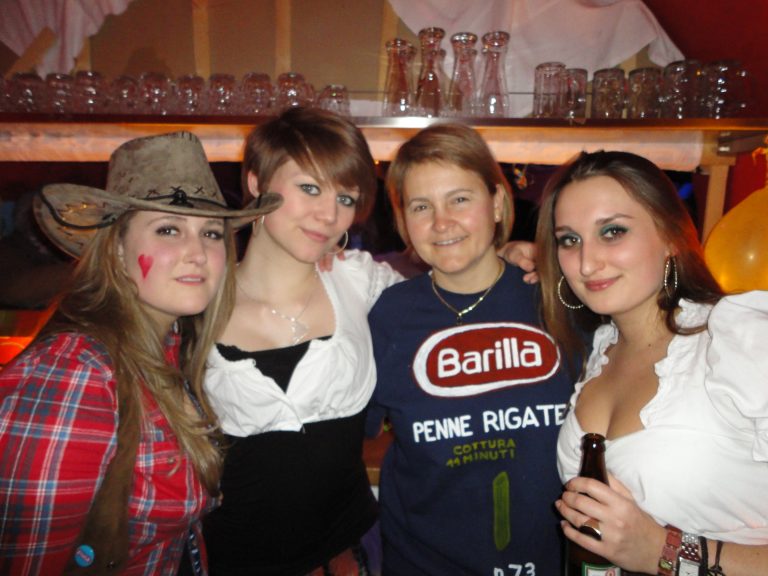
Then, in 1986, reconciliation: “The Imaginary Invalid,” Molière! Classic and entertainment in one—unforgettable Erol Ünsalan as Argan, who would later work successfully for many years as an actor. The photos of the production still hung for decades in the Steiner corridors. And even after this theatre era shaped by the author, things continued splendidly. Equally unforgettable for all who took part or saw it: “Arsenic and Old Lace,” gripping in the leading roles Tino Dietrich and Sebastian Dehnhardt. This brief excursion into the Steiner playbill of the 80s would be quite incomplete without a remembrance of the second pillar of Steiner cultural highlights: Fasching. The months-long preparations, from the search for the motto to the artistic decoration of the rooms, welded the voluntary helpers closely together; the resounding celebration crowned their efforts.

Two particularly lavish Fasching celebrations in the decorated gymnasium stand out: the intergalactic Fasching under a “real” starry sky—black-painted paper strips had been perforated with nails with endless effort. Through the holes, the light then glittered deceptively like flickering stars and imitated the vastness of outer space. And at the “Night of the Clowns,” four larger-than-life clowns stood by the dance floor and watched over the dancers. “Yes, the Fasching and theatre times were always the happiest,” Olaf Ziegler once wrote. “Out of initial chaos, unfulfillable wishes, with overestimated possibilities—out of all those good and evil dreams, in play there succeeded many a profound transformation and development of a youthful personality.”

With the 80s, however, things also became somewhat quieter around the annual productions; other events in the Steiner year gained new significance. This too a sign of the change that, in retrospect, was clearly taking shape. No fewer than four staff members from school and boarding house, who had decisively shaped the school almost from the very beginning, departed in the 80s. Hilde Weymar, highly cultivated housekeeper for 30 years and close companion of Angi Ziegler, died after a short, severe illness in 1981. The following year “Poldi,” Dr Gerhard Rasch, retired; Helmut Konrad, legendary sports teacher since Ilse Wiskott’s time, followed shortly thereafter. And finally Frieda Herbst, the Austrian cook with a heart of gold, also left her sphere of activity on the ground floor of the Steiner Schloss. The memory of each of these personalities would fill volumes.

Pupils and teachers in the 80s

It was not always possible to fill the gaps with equal strength. In the kitchen, however, Margot Kirchner arrived in 1982, a cook who was able to fill her realm over the following two decades much as her predecessor had. Angi Ziegler recalls how she and Margot would scour the latest issues of the newspaper Essen & Trinken for inspiration. “We thought about,” says Angi Ziegler, “how we could make all of this a bit simpler for pupils. Back then the menu plans were much more varied. Today they don’t eat all that anymore.” This endeavour to make home and school more beautiful for the children is, for Angie Ziegler, a key hallmark of the 80s in Stein. “I think people wanted to leave behind all the dreariness of the 70s—RAF and all that.”

The school made the start in 1980; before the comprehensive renovation, the entire school building was allowed to be turned upside down by the pupils, “from attic to cellar.” The newly built riding hall followed. And a library in the school building. For Angi Ziegler, however, the showcase project of those years remains the redesigned club. “We wanted to get away from that grimy vault,” says Angi Ziegler, “with cables hanging everywhere and the stench of old beer. They simply had no sense of aesthetics. Everything dirty and grubby and dreadful.”

Angi Ziegler waxes lyrical when she speaks about the refurbishment of the club. At Radspieler in Munich, an equally fine and inexpensive fabric was found for the seat covers. “All light colours, a cotton rib—beige base with a delicate light-blue pattern. Very elegant!” The saddler and upholsterer in Stein did a thoroughly professional job. The seats, previously old beer crates, were bricked up and whitewashed. “All a bit Morocco.” The small side tables were clad with brass; artificially aged mirrors hung on the walls. Angi Ziegler recalls with happiness how Nadine Schröder finally brought a few little orange trees as decoration.

Opening of the new school building

As elegant and light and bright as the renovated club, so the entire 80s appear to Angi Ziegler in retrospect—also in the life together with the pupils. For the first time, young Steiners, among them the author, voluntarily and gladly sat down at the Zieglers’ dining table. That, too, as she emphasises, was an important turning point for Olaf and Angi Ziegler. “We laughed so much; it was wonderful.” In those days, a closeness grew between the Zieglers and the pupils that is quite unusual for a normal school. A fine, a final example of this is the annual class trip of Year 11 in 1988 to Paris. Olaf and Angi Ziegler often travelled along then, especially when it was to France.

The city’s flair had its effect. Many a Steiner pupil was, after seven days’ stay, as if transformed; and the journey had not passed Olaf Ziegler by without leaving its mark either. In front of Sacré Coeur, a beggar played a clarinet. For a small tip he was willing to accompany Olaf Ziegler, who then presented arias from Don Giovanni to the Steiners and the public. The involuntary listeners applauded enthusiastically and even threw a few coins into the clarinettist’s hat.

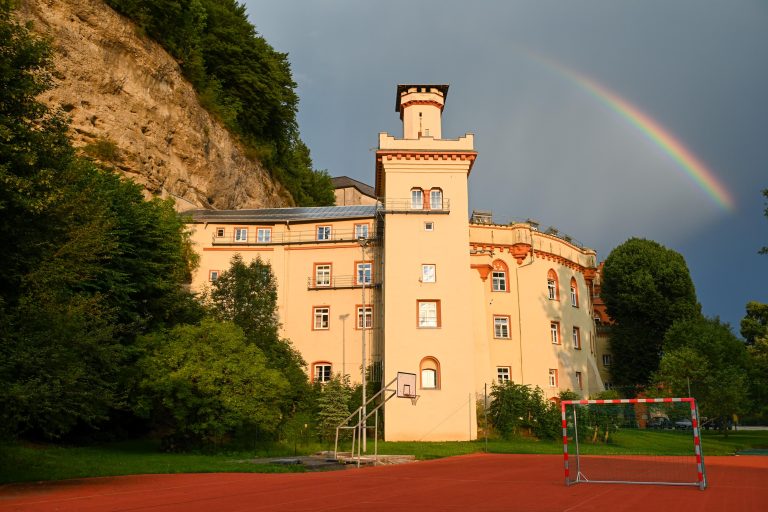
“When I look down from above over the years, then I notice what differences prevailed there—of the spirit of the times, of culture, of everything that was important to us,” Angi Ziegler sums up after more than an hour of conversation about the 80s in Stein. “It was a happy time, sunlit.” Soon the tide was to turn. In the 90s, Olaf Ziegler’s health began to decline. His son Sebastian, who had taken his Abitur in Stein in 1984, would eventually take over. All the more precious, for Angi Ziegler, are the memories of the carefree 80s.

Ski camp in the 80s

Stein in History:

baccalaureate school schloss stein b229

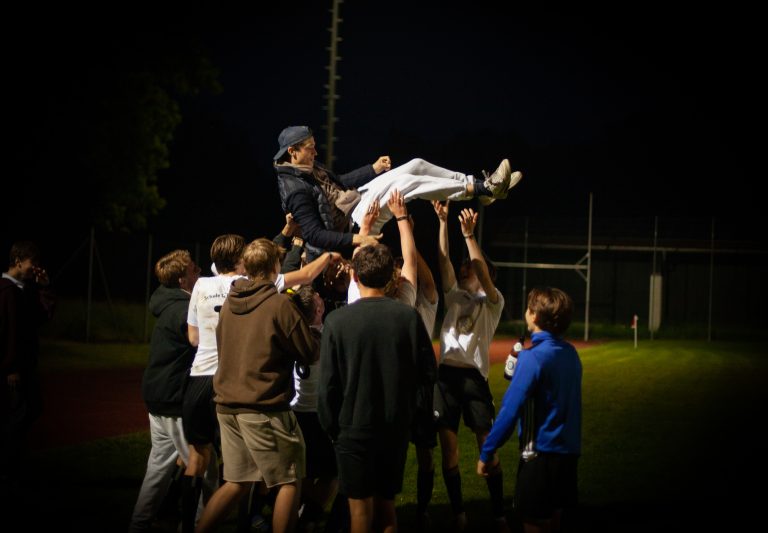
The 2020-2024 school leavers

The graduating classes of 2020-2024 look back on years full of challenges, solidarity and unforgettable moments. Between corona, new projects at boarding school and personal experiences, they talk about what Stein meant to them during this special time.
dsc02513

Stein in History: The 2010s

New paths, significant changes – and memories that endure. The 2010s at Stein were a decade of great dynamism: The new Abitur, modern technology, new faces, and a strong sense of togetherness shaped daily life. Those who were here at the time recall not only lessons and examinations, but also community, friendships, and that special feeling of being at home in Stein.